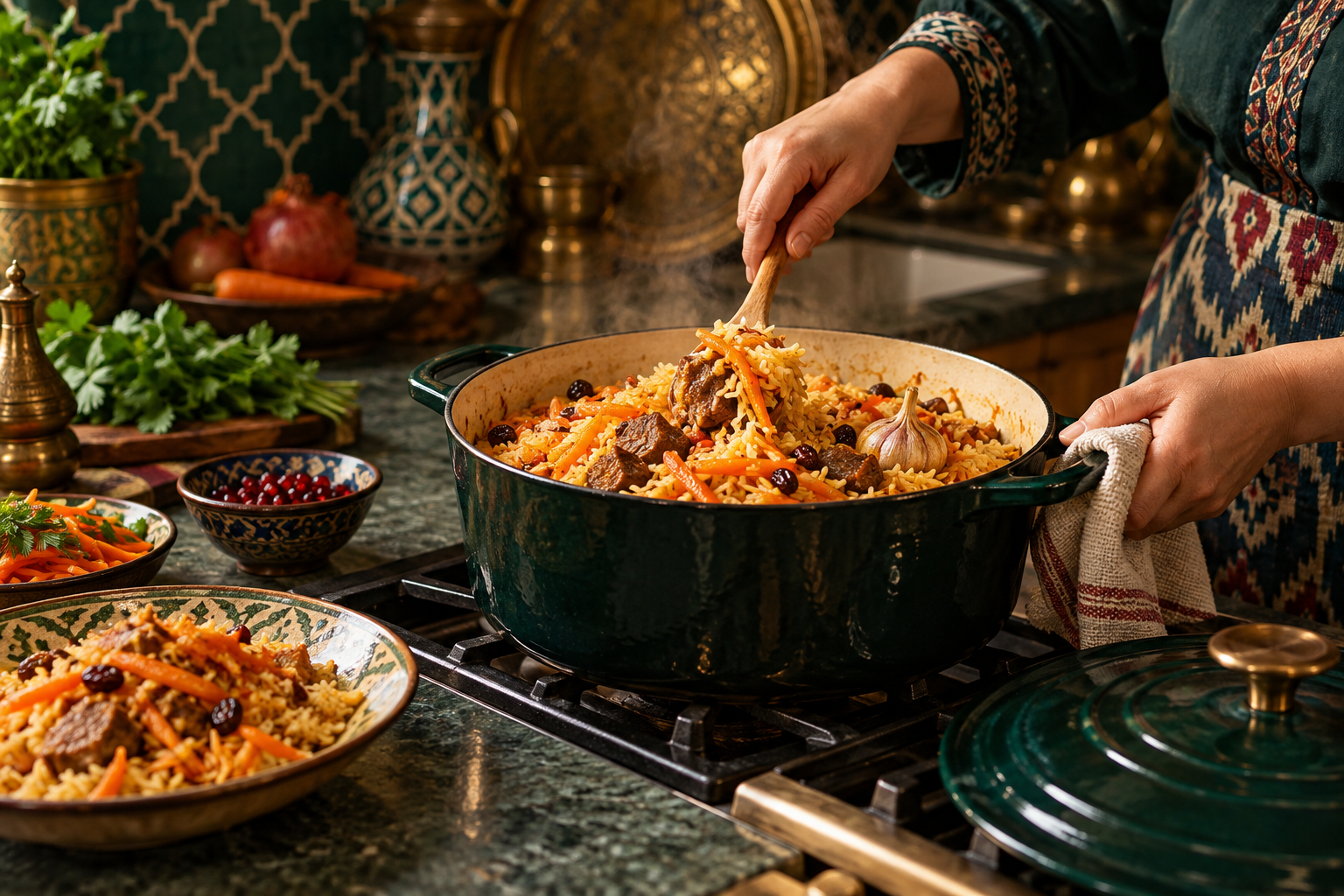
A heavy home pot can make a practical place to learn plov. The question is how your recipe fits that vessel, not whether a particular pot name guarantees authenticity.
Choose a Dutch oven method for plov
Read the recipe’s suggested vessel and batch size. Leave the room it requires for ingredients, liquid and handling. A Dutch oven should have a well-fitting lid and enough working space for lifting the finished rice.
Set up a heatproof landing place before you start. Heavy cookware becomes awkward when full, so plan how you will serve without carrying an unnecessarily large hot pot through a crowded room.
Manage the heat transition
A heavy pot can stay hot after the burner setting changes. Follow a method written for your equipment and pay attention when moving from browning to a gentle finish. Do not assume that turning the dial down instantly changes every part of the vessel.
If the base starts catching, adjust the cooking process as the recipe allows. Avoid aggressive scraping after the rice has begun its finishing stage. That can distribute a burnt flavour through the dish.
Keep the equipment note
Record the vessel, burner and batch you used. If you later move to a thinner pan, the same method may need attention. Your notebook should preserve those observations alongside the grain and liquid notes. Read our liquid guide.
Frequently asked questions
Do I need a kazan to try plov at home?
Choose a home recipe that explicitly suits the vessel you own.
Can I use the same timing for every pan?
No. Follow a compatible method and observe how your equipment behaves.
Can I make plov in a Dutch oven?
Yes, choose a recipe written for a suitable heavy home pot and batch. Check the lid, capacity and heat setup. Record your actual vessel so that the method you learn can be repeated instead of attributed to a pot name alone.
Can I cook plov without a kazan?
Use a home method explicitly compatible with the cookware you own. Equipment can be adapted thoughtfully, but the recipe’s preparation and heat stages still matter. A claim of authenticity is not a substitute for workable instructions.
What size pot do I need for plov?
Check the selected recipe’s vessel guidance and the full ingredient volume. Leave enough working space for cooking and serving. Do not use a fixed pot size for every batch or force a scaled celebration recipe into a small saucepan.
How do I stop a heavy-pot plov from catching?
Follow the heat transitions in the selected method and observe the base. A heavy vessel can retain heat after a dial adjustment. Correct the process deliberately; aggressive stirring late in the grain stage is not a universal solution.
Sources & editorial notes
Original Tales & Table editorial guidance. Linked sources support the cultural, rice or safety points identified in the text. Recipe ideas are original kitchen drafts and have not been tested by our kitchen.